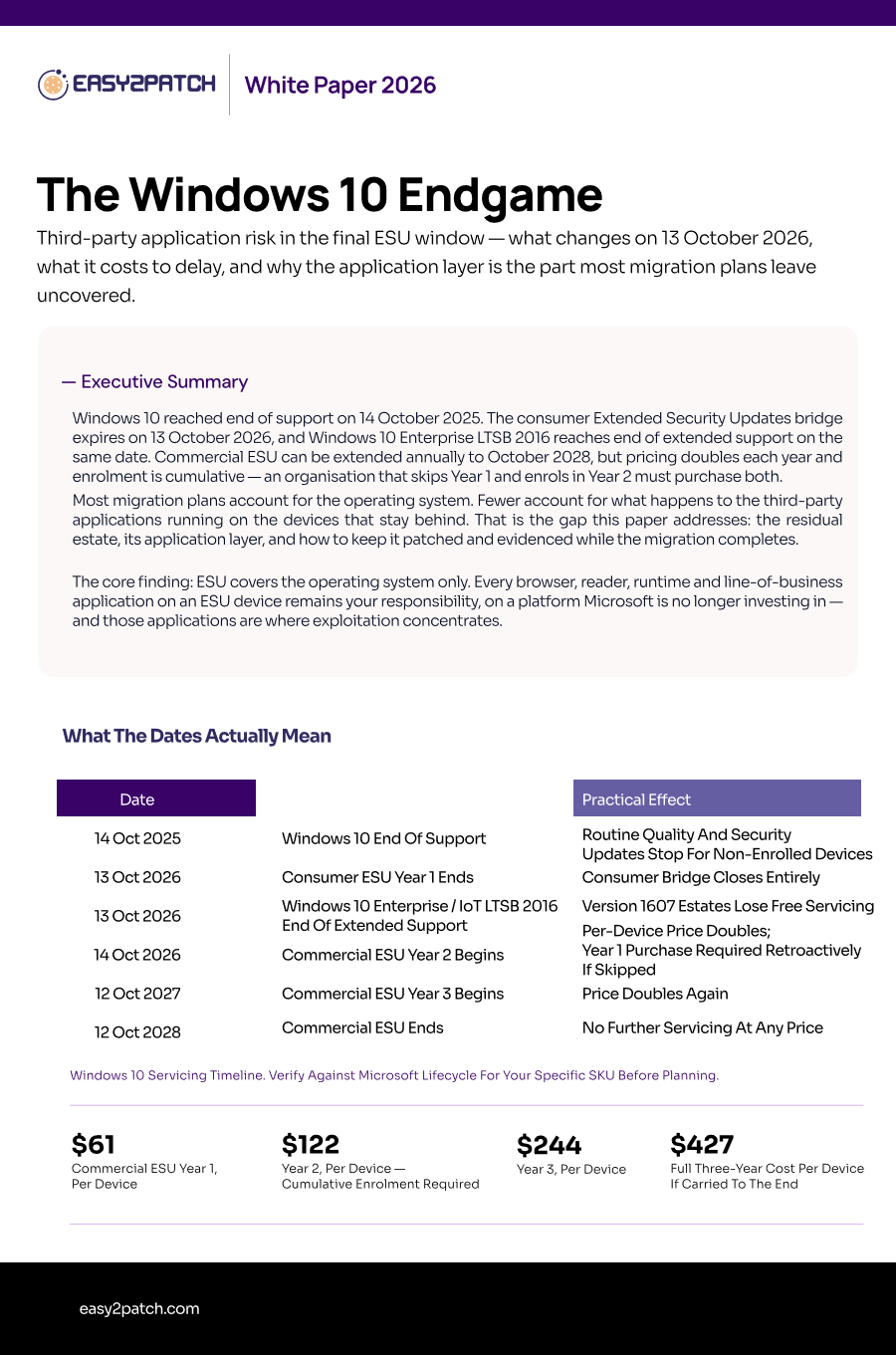
The Windows 10 Endgame: Third-Party Application Risk in the ESU Window
The Windows 10 Endgame: Third-Party Application Risk in the ESU Window
What the paper covers
Rather than restating Microsoft's lifecycle dates, this paper works through the operational consequences: the per-device cost curve from Year 1 to Year 3; who realistically stays on Windows 10 and why — hardware ineligibility, unvalidated line-of-business software, attached equipment, procurement timing; and the three compounding effects that make a residual estate deteriorate quietly, as vendors drop Windows 10 from their supported-platform matrices, tooling gets rebuilt around the migrated population, and devices labelled “being replaced” stop generating priority. It closes with a four-label disposition framework — Migrate, Replace, ESU bridge, Isolate — with the application-patching requirement, named owner and dated exit plan each label implies.